AI-Native Research: 6 Ways Investors Use Kaleidoscope MCP
Research used to be a workflow: log into a platform, click through menus, export to a spreadsheet, stitch it into a doc. With Kaleidoscope MCP connected, it's a question. You ask in plain English; Claude (or ChatGPT, Gemini, or any MCP client) figures out which tools to call, composes them, and returns a synthesized read — every fact cited to a source filing and accurate as of any date.
Here are six things investors are actually doing with it, each shown as a real prompt and the answer it produces.
Brief a name in seconds
Using Kaleidoscope, show me the recent management / board changes for TSLA. Also the latest risk factors.
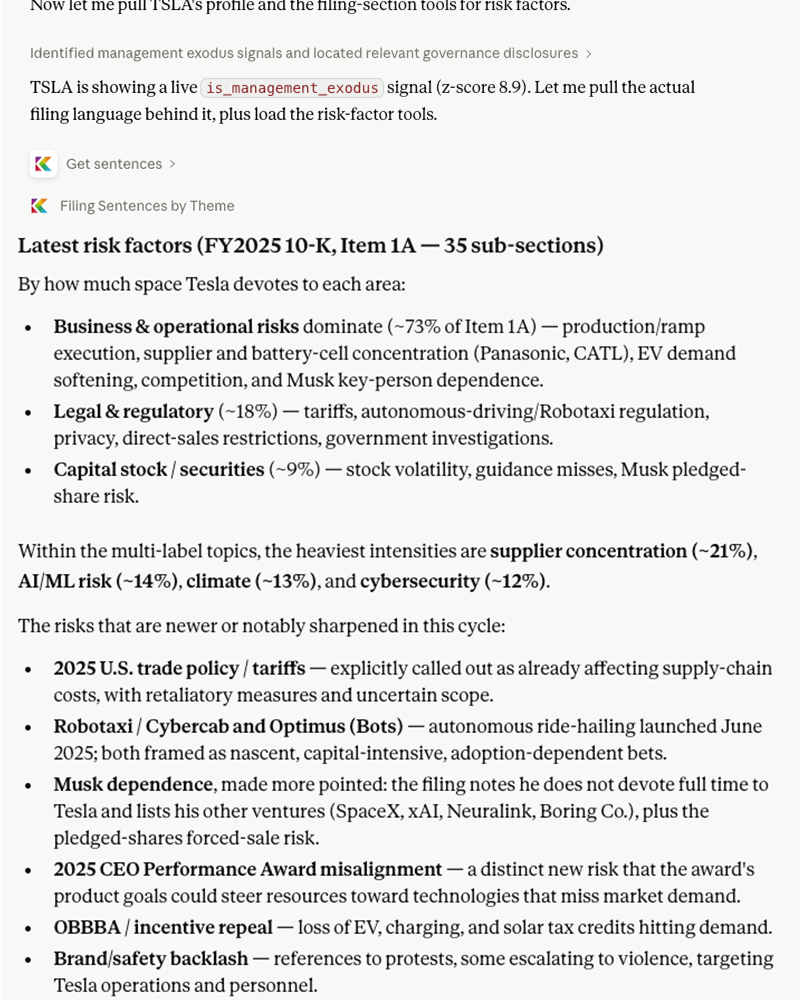
Why it matters: one question replaces an afternoon of pulling 8-Ks, the proxy, and the 10-K risk section by hand — and every line comes back traced to the filing it came from.
See where institutional money is rotating
Which stocks saw the biggest cluster of notable funds entering (or exiting) last quarter?
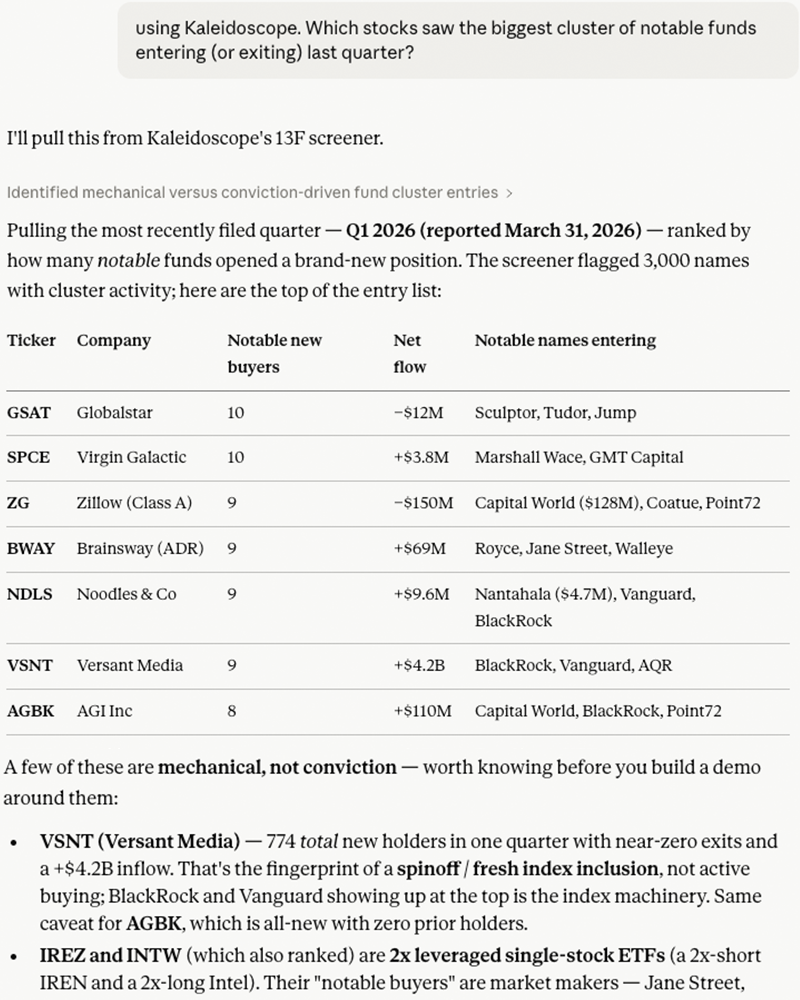
Why it matters: crowd-ins and crowd-outs across hundreds of notable funds in a single call — share-based actual trading, not price-inflated values that just track the market.
Screen a whole sector for distress
Which industrials have rising distress signals and filed restructuring-language or non-reliance 8-Ks in the last 90 days?
Claude calls search_classifiers to find the right filing themes, then screen_companies across pre-aggregated signals over 152M filing sentences — filtering on distress echo, SIC range, and 8-K item codes 4.02 and similar.
It returns a ranked shortlist: each name with its distress_echo score, the specific 8-K item that triggered, and the days since filing — every row cited to the underlying filing.
Why it matters: a multi-hour batch job for an analyst — done in one sub-second query, with the receipts attached.
Catch activist campaigns early
Show me active hostile activist campaigns demanding board seats — and everything Pershing Square holds above 5%.
Claude calls search_activist_positions over 13D/13G filings — event-driven data filed within ~10 days of crossing 5%, not the 45-day-lagged quarterly 13F.
Each result carries the stated purpose of transaction, the accumulation trail (first % → latest %), and LLM-classified intent (board representation, proxy fight, M&A) and tone (hostile / friendly / neutral).
Why it matters: you see a campaign forming weeks before quarterly institutional data would ever surface it.
Check a manager's real track record
What's this fund manager's actual track record versus the market over the last two years?
Claude resolves the filer with thirteenf_search_managers, then calls thirteenf_manager_performance for the disclosed-long-book replication return — trailing performance and excess vs SPY across 8 quarters.
The answer states its methodology and priced-coverage on every number, and is clearly labeled a 13F-replication proxy — not audited fund returns.
Why it matters: Claude alone can quote a fund's AUM and famous trades — it can't compute its return. This can, with the caveats attached.
Rank the catalysts that actually moved a stock
What news moved this ticker the most over the past year?
Claude calls search_news_articles in catalyst-ranking mode — article-level data with a 9-class event taxonomy (M&A, legal, regulatory, capital action…), a materiality score, and 3-day & 5-day price-move correlation.
It returns the events ranked by actual market impact, deduped to one row per story, with promotional content filtered out.
Why it matters: you rank catalysts by what they did to the price, not by how recent or loud they were.
The interface is a question. The answer is cited.
None of these are copy-paste from a terminal. You ask once; Claude composes the right Kaleidoscope tools, and hands back a synthesized read you can verify down to the filing — as of any date, with the failures counted. That's the difference between an AI that sounds confident and one you can actually trust with a position.